Weather Regimes
Every other route answers how warm, how wet. This one answers how the months will be assembled: the seven recurring shapes of the Euro-Atlantic circulation, and how SEAS5's fifty-one members distribute the season across them — with the skill record printed beside every number, because a regime frequency without one is a horoscope.
Regimes
Members
Fitted on
Biggest tilt
How the season assembles
51 members · initialised October 2026| Regime | Oct* | Nov | Dec | Jan | Feb | Mar | Apr |
|---|---|---|---|---|---|---|---|
| EuBLEuropean blocking | 22%+6 | 7%-6 | 8%-5 | 11%-3 | 10%-4 | 7%-6 | 15%+0 |
| ScBLScandinavian blocking | 15%-4 | 18%+4 | 14%+1 | 14%+2 | 8%-3 | 14%+3 | 17%+5 |
| ScTrScandinavian trough | 12%-4 | 10%-4 | 11%-3 | 12%+0 | 14%+3 | 12%-0 | 10%-2 |
| ZOZonal (NAO+) | 32%+19 | 15%-1 | 18%-0 | 9%-11 | 7%-12 | 12%-5 | 14%-2 |
| ATAtlantic trough | 8%-6 | 16%+1 | 17%+1 | 15%-1 | 12%-4 | 14%-3 | 18%+1 |
| ARAtlantic ridge | 9%-2 | 15%+1 | 18%+6 | 17%+4 | 19%+6 | 21%+7 | 17%+2 |
| GLGreenland blocking (NAO−) | 2%-10 | 19%+6 | 14%-0 | 24%+8 | 31%+14 | 20%+5 | 10%-3 |
Bold is the share of the 51 × days member-days in that regime; the small number is the tilt against the model's own 1993–2016 climatological share, in points. Coloured cells tilt by three points or more. Dimmed cells sit where the reforecast RPSS for that regime and month is at or below zero — the model has no record of getting that number right, so read them as decoration. * marks the initialisation's own, part-elapsed month.
The seven patterns
ERA5 z500 anomaly composites · fixed ±120 gpm scaleEuBL European blocking
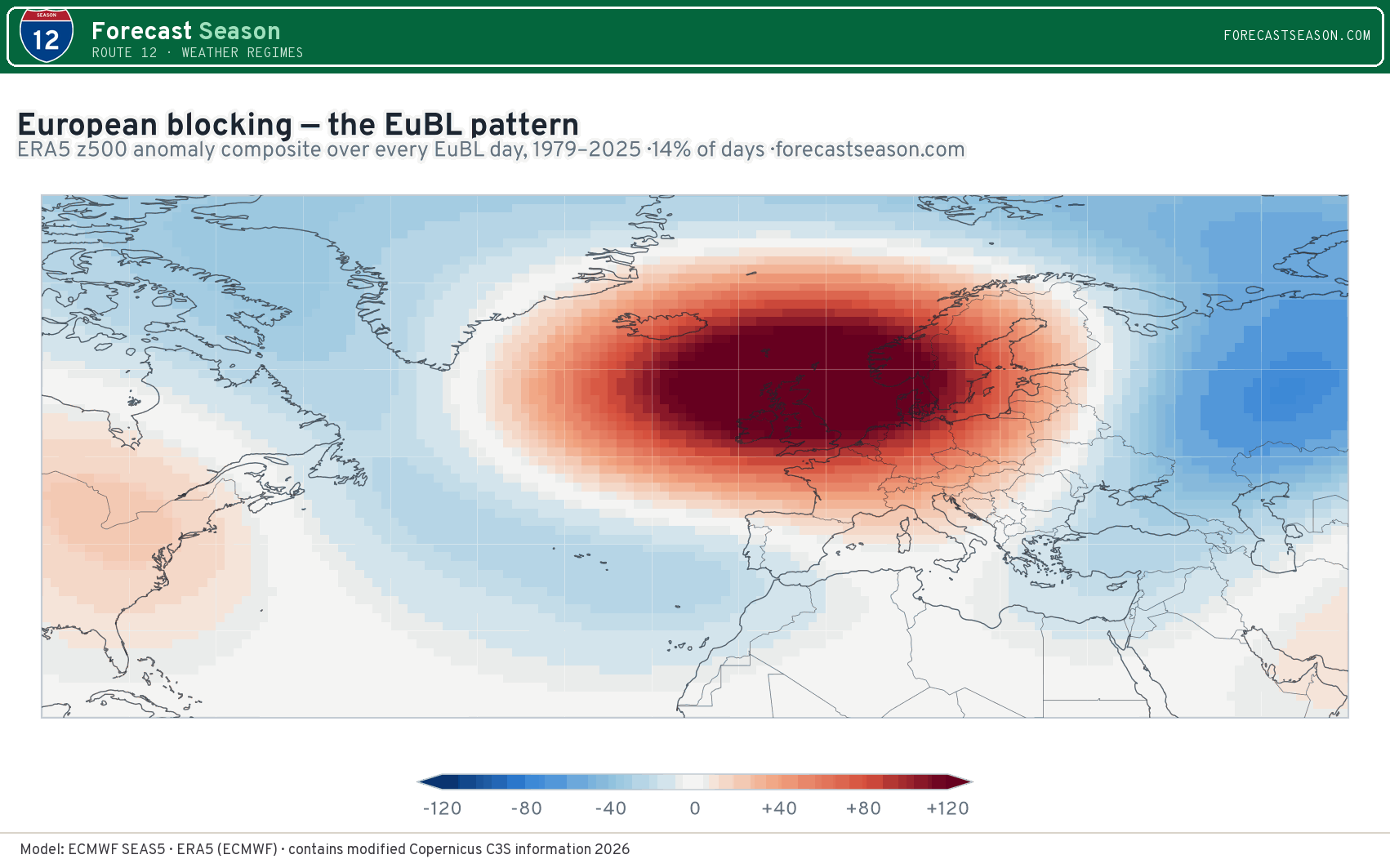
High pressure sits on central Europe and everything goes quiet: inversion cold and fog in winter, heat in summer, Atlantic systems detouring north.
ScBL Scandinavian blocking
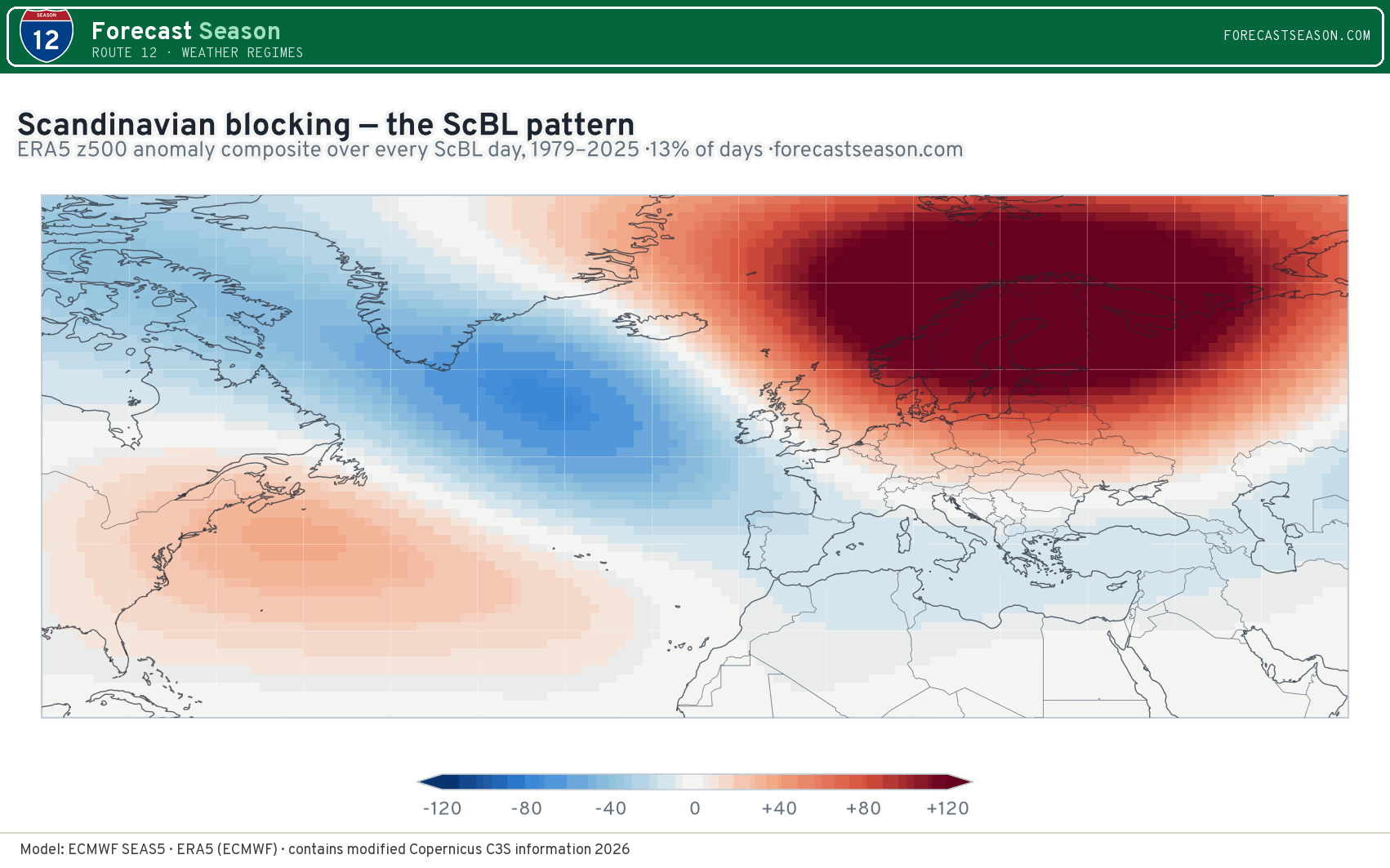
The block sits over Scandinavia and the low-level flow beneath it turns easterly — the classic delivery mechanism for continental cold into northern and central Europe in winter.
ScTr Scandinavian trough
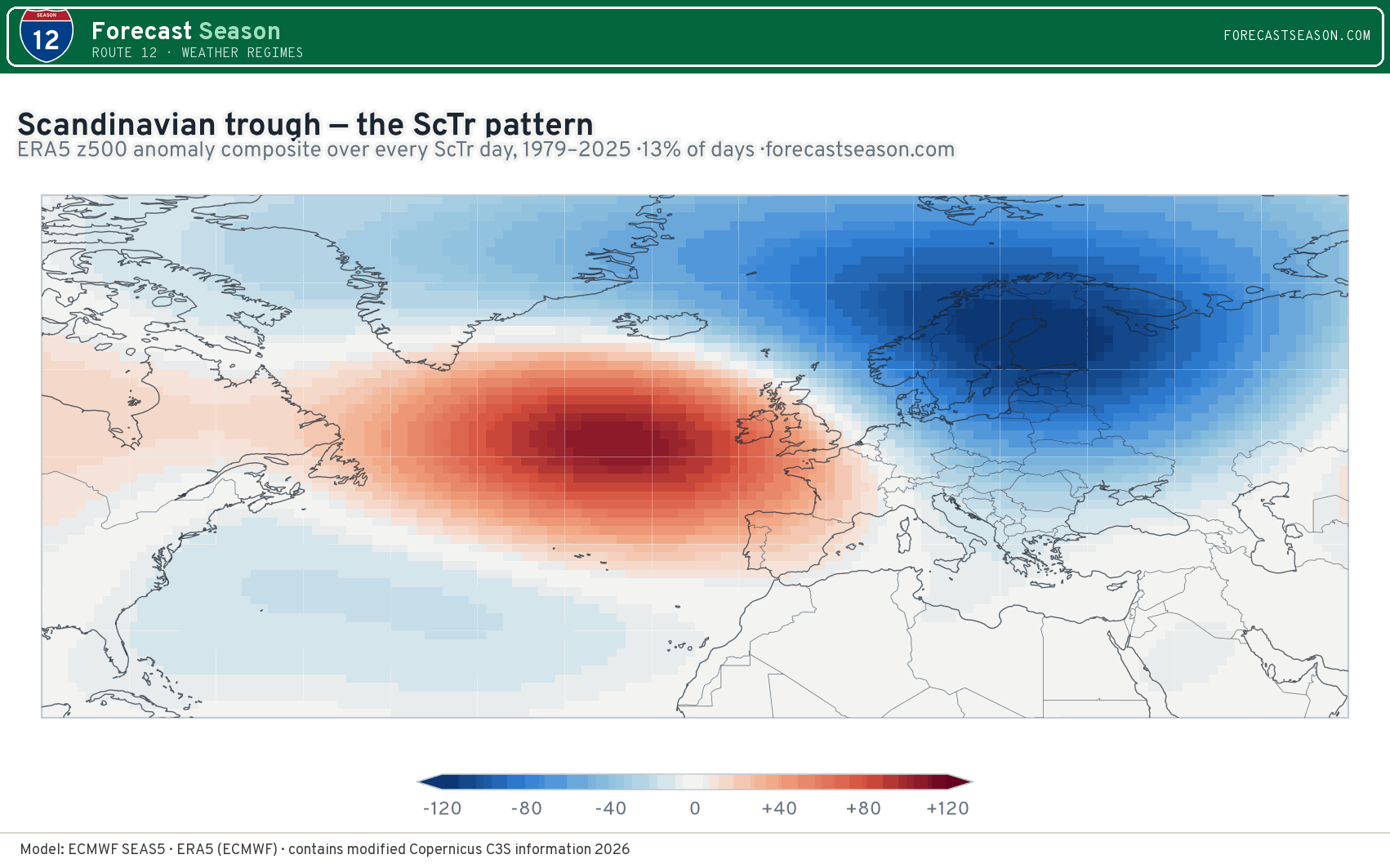
A trough digs over Scandinavia beneath an upstream ridge: cool showery northerlies for northern Europe, milder air hanging on to the south-west.
ZO Zonal (NAO+)
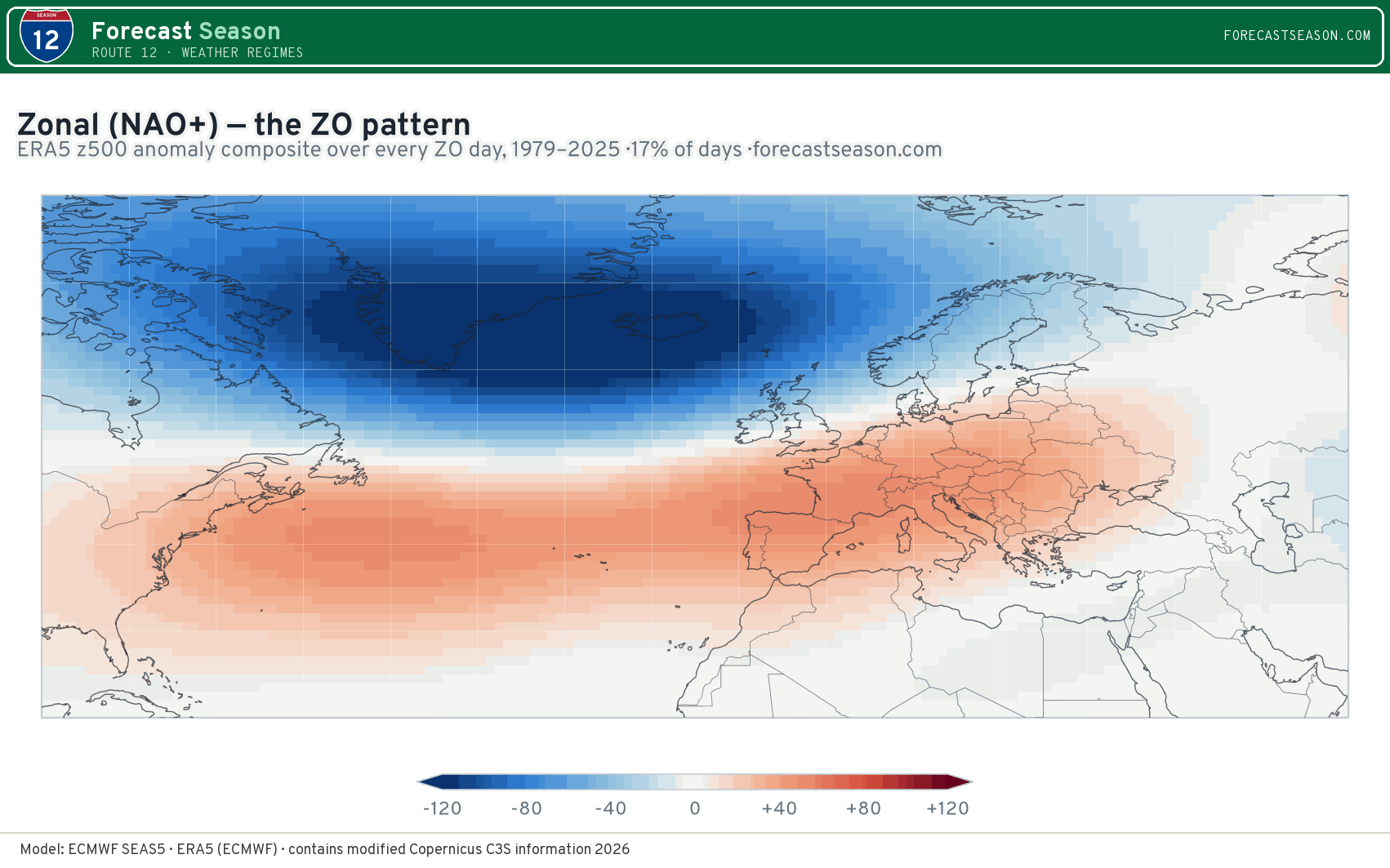
Strong westerlies ride a deep Iceland low. Mild, wet and windy for north-west Europe, mild for the eastern United States; the real cold stays locked in the Arctic.
AT Atlantic trough
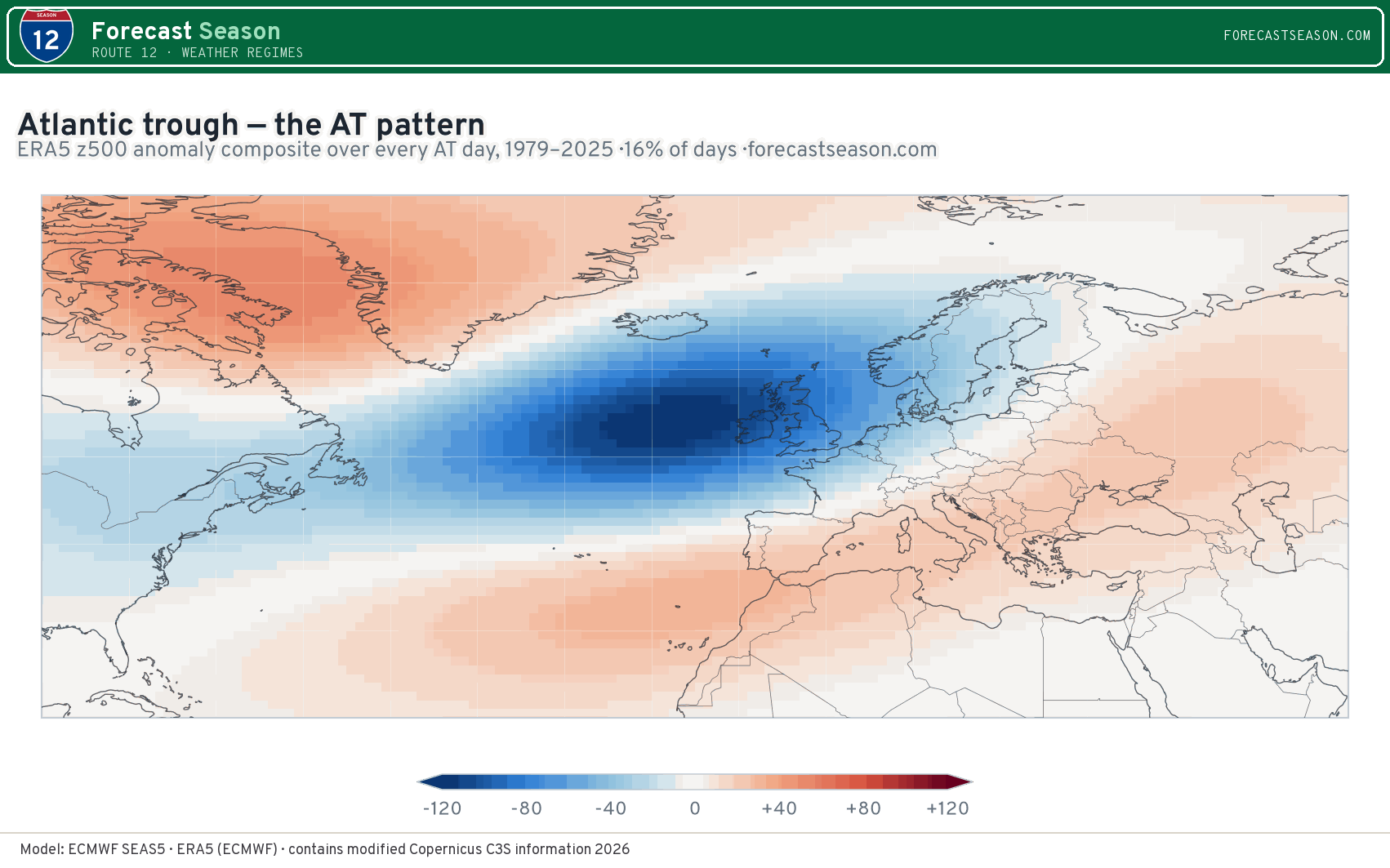
A trough parks over the central Atlantic and the flow turns south-westerly downstream: mild and unsettled for western Europe, with the storm track aimed at Britain and Biscay.
AR Atlantic ridge
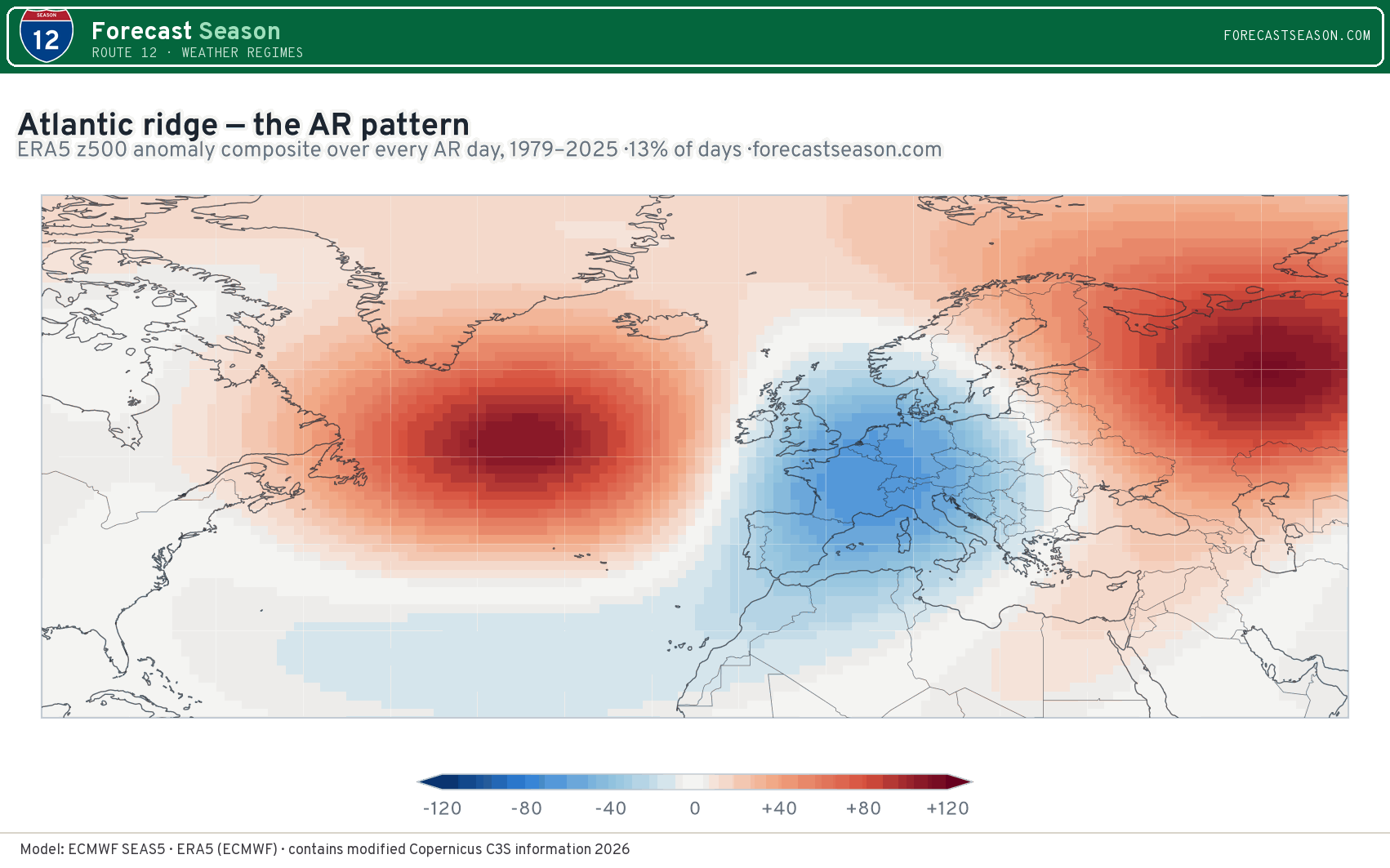
A ridge builds in mid-Atlantic and the flow curls northerly around its eastern flank: cooler for western Europe, storms deflected toward the Nordic seas.
GL Greenland blocking (NAO−)
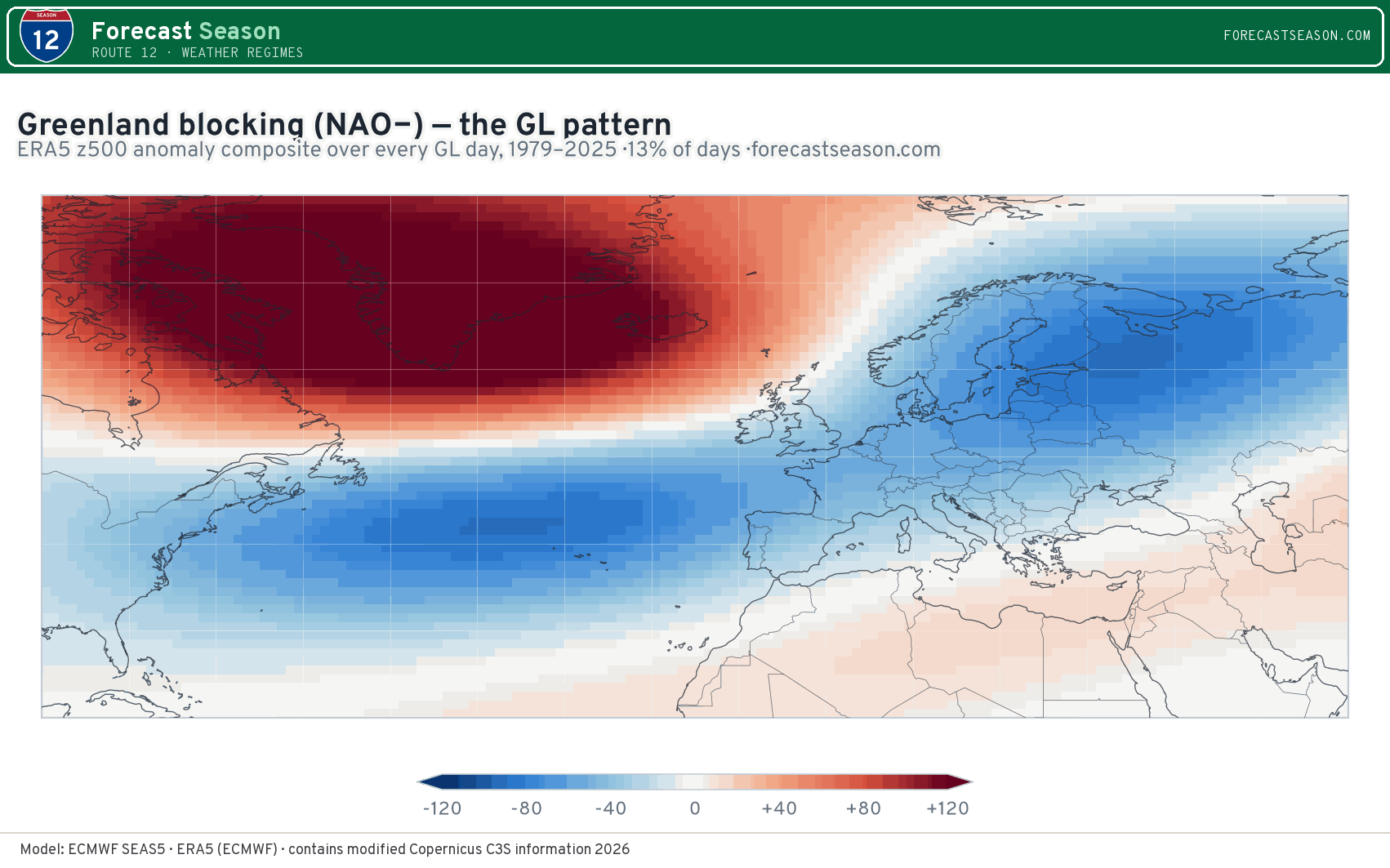
The block sits on Greenland and the jet is shoved south — the NAO− state. Cold for northern Europe and the eastern United States, wet for southern Europe; the pattern behind most memorable European cold spells.
The scoreboard
24 reforecast years vs ERA5| Regime | Oct* | Nov | Dec | Jan | Feb | Mar | Apr |
|---|---|---|---|---|---|---|---|
| EuBL | +0.21 | -0.07 | -0.01 | +0.02 | +0.04 | -0.09 | -0.06 |
| ScBL | +0.26 | -0.07 | -0.17 | +0.01 | +0.04 | +0.10 | +0.03 |
| ScTr | +0.45 | +0.04 | +0.01 | +0.15 | +0.05 | +0.21 | +0.02 |
| ZO | +0.21 | +0.03 | +0.08 | +0.06 | +0.01 | +0.16 | +0.04 |
| AT | -0.11 | +0.14 | +0.07 | +0.15 | +0.10 | -0.20 | +0.03 |
| AR | +0.19 | +0.18 | -0.02 | -0.06 | +0.13 | +0.06 | -0.01 |
| GL | +0.21 | +0.04 | +0.00 | +0.06 | +0.18 | +0.21 | +0.04 |
Leave-one-out tercile RPSS of monthly regime frequency over the 24 reforecast years, verified against ERA5; hover a cell for the ACC. Zero is climatology. Teal beats it; brown does not. The pattern to notice: nothing in September–October, and what skill exists in winter sits in the NAO-adjacent regimes — which is exactly what the published literature finds for SEAS5.
How it is made
ERA5 daily 500 hPa height since 1979 is reduced to anomalies against a smoothed calendar-day climatology, normalised by each day's own climatological spread (without this, every cluster is a winter cluster), low-pass filtered, and clustered by k-means in the space of the ten leading EOFs. SEAS5's daily z500 — all 51 members, and the 25-member reforecast of 1993–2016 behind them — is put through the identical pipeline after removing the model's own lead-dependent climatology, so model drift cannot masquerade as a circulation trend. Every member-day lands on its nearest regime; the tables above are nothing but counting. Skill is measured the way the rest of this site measures it: the reforecast's own 24 years, scored against what ERA5 says actually happened, leave-one-out. Reference: Grams, Beerli, Pfenninger, Staffell & Wernli (2017), Nature Climate Change; method as in the ECMWF regime products.